

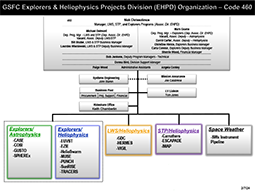
The Explorers and Heliophysics Projects Division (EHPD) consists of three programs: Explorers, Living With a Star (LWS), and Solar Terrestrial Probes (STP). The Explorers Program is an uncoupled Program which provides frequent flight opportunities for world-class scientific investigations from space within NASA Heliophysics and Astrophysics Space Science goals. Explorers projects are typically implemented in the Principal Investigator (PI) mode. The LWS Program is a loosely coupled Program which provides missions to improve our understanding of how and why the Sun varies, how the Earth and Solar System respond, and how the variability and response affects humanity in Space and on Earth. The STP Program is an uncoupled Program which provides missions to understand the fundamental physics processes from the Sun to Earth, to outer planets, and beyond to the interstellar medium.
>> Find out more about Explorers,
Living With a Star, or
Solar Terrestrial Probes.
 |
 |
 |
Updated 04.2024
>> Org Charts
NET = No Earlier Than
JFY = Japanese Fiscal Year